Scientists Tracked 6,000 Penguin Dives to Solve a Surprising Food Mystery
A study of Adélie and chinstrap penguins finds that Antarctic prey becomes harder to reach through relocation, not depletion, as hunting continues.
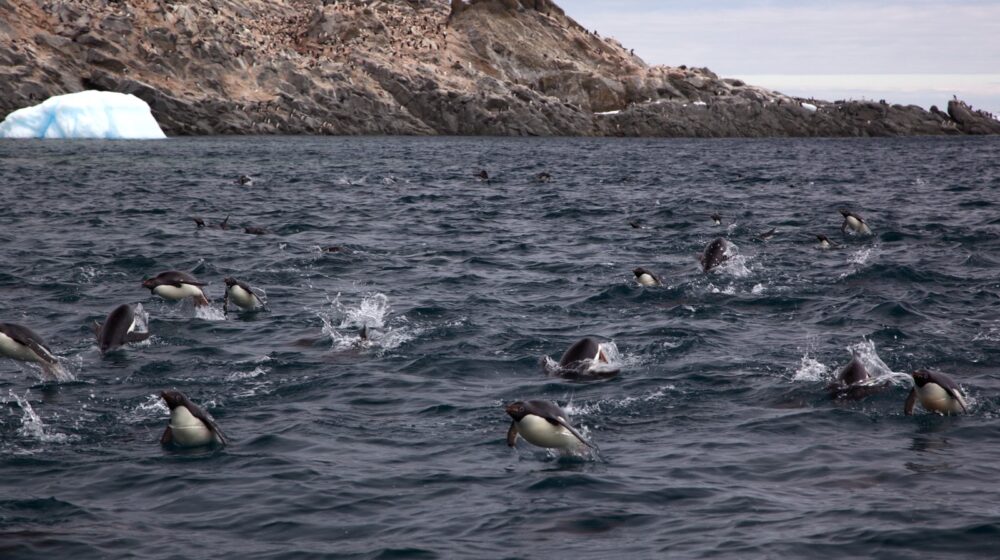
Two separate penguin studies from opposite corners of Antarctica are converging on the same conclusion: catching enough food in the Southern Ocean is less about how much prey exists and more about how easy that prey is to reach.
The first, led by Hina T. Watanabe, a postdoctoral scholar at Japan’s National Institute of Polar Research, tracked breeding Adélie penguins in East Antarctica by fitting them with bio-logging devices that recorded dive depth, movement and feeding events in three dimensions, supported by video. Thick sea ice covering the bay forced the birds to enter and exit the water through only a few shared holes, concentrating their hunting in the same locations. Across 30 foraging trips and 23 tracked penguins, the team logged more than 6,000 dives, published 15 July in the Proceedings of the Royal Society B.
The pattern was clear: penguins repeatedly using the same entry point had to dive deeper and swim farther to reach prey with each trip, yet once they found krill, their feeding rate stayed the same as always. ‘Food can become harder to obtain even when it has not necessarily been depleted,’ Watanabe said, adding that prey accessibility, not just abundance, shapes how the birds hunt.
A separate study on chinstrap penguins in the Scotia Sea adds further weight to the idea. Researchers there tracked 45 breeding chinstrap penguins from colonies on Monroe and Powell Island during 2022 and 2023, combining the tracking data with underwater acoustic surveys of krill. Antarctic krill migrate vertically each day, staying deep during daylight to avoid predators that hunt by sight, then rising closer to the surface at night to feed on algae.
Chinstrap penguins exploit this rhythm by concentrating their hunting at dawn and dusk, when krill are easiest to reach near the surface — a strategy that requires far less energy than diving deep during daylight hours. When they did hunt in daylight, the birds stayed closer to their colony but had to dive much deeper, creating an energy trade-off against the need to return quickly and feed hungry chicks. Notably, the chinstraps did not always head for the largest krill swarms, often choosing smaller groups that were simply easier to reach.
Both studies point to the same underlying pressure: as climate change, shrinking sea ice, recovering whale populations and commercial fishing continue to reshape the Southern Ocean, penguins may struggle to find enough food even in years when krill numbers remain healthy, because the krill themselves are becoming harder to reach.
Wikimedia Commons/by Jason Auch

Leave a Reply