How Does A Fish Hide From Science For 66 Million Years? Ask The Coelacanth
A coelacanth, presumed extinct for 66 million years, was discovered alive in a fishing trawler's catch off South Africa in December 1938.
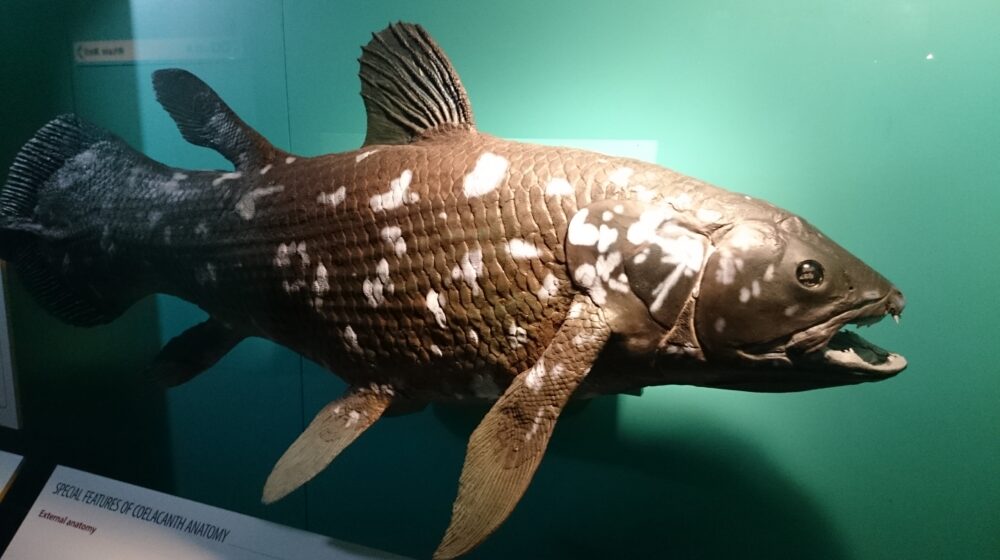
How does a fish stay hidden from science for 66 million years? For the coelacanth, the answer lay in the deep waters off South Africa, until a fishing trawler pulled one out of the ocean in December 1938, forcing researchers to rewrite what they thought they knew.
Museum curator Marjorie Courtenay-Latimer noticed the unusual catch straightaway: a fish roughly 1.5 metres long, covered in heavy, armour-like scales, with fleshy fins that looked nothing like those of typical fish. She passed on a description and sketches to South African ichthyologist J.L.B. Smith.
Weeks later, after examining the preserved specimen, Smith identified it as belonging to a group previously known only from fossils, a lineage that had seemingly disappeared from the record around 66 million years ago. He named the species Latimeria chalumnae, after Courtenay-Latimer and the nearby Chalumna River, the Natural History Museum notes.
The coelacanth’s decades of concealment come down to habitat: it lives hundreds of metres underwater, hiding in caves by day and hunting squid, cuttlefish and smaller fish by night, in depths well beyond routine human observation. Fishermen in the Comoros Islands, notably, already knew the species by its local name, ‘gombessa’, long before it became a scientific sensation elsewhere.
As a lobe-finned fish, the coelacanth’s fins attach to muscular lobes rather than the thin rays seen in most modern fish, a trait that once suggested it might be a missing link to the first land vertebrates. Genetic studies later found lungfish to be the closer relatives instead, though the coelacanth keeps its own unusual features, including a flexible notochord rather than a bony spine and a rare skull joint letting its mouth open unusually wide.
The species kept resurfacing after 1938: a second specimen was found in the Comoros Islands in 1952, and in 1997 a coelacanth turned up at an Indonesian market that genetic testing identified as a distinct species, Latimeria menadoensis, proof that this ‘living fossil’ lineage has continued evolving, not standing still, throughout its long history.
Wikimedia Commons/by Nkansah Rexford

Leave a Reply