A Physicist Built a ‘Big Bang’ and ‘Big Crunch’ Inside a Lab to Study Where Time Comes From
Using a cloud of ultracold atoms, a University of Birmingham physicist recreated 'Big Bang' and 'Big Crunch' moments in miniature to study how time emerges without an external clock.
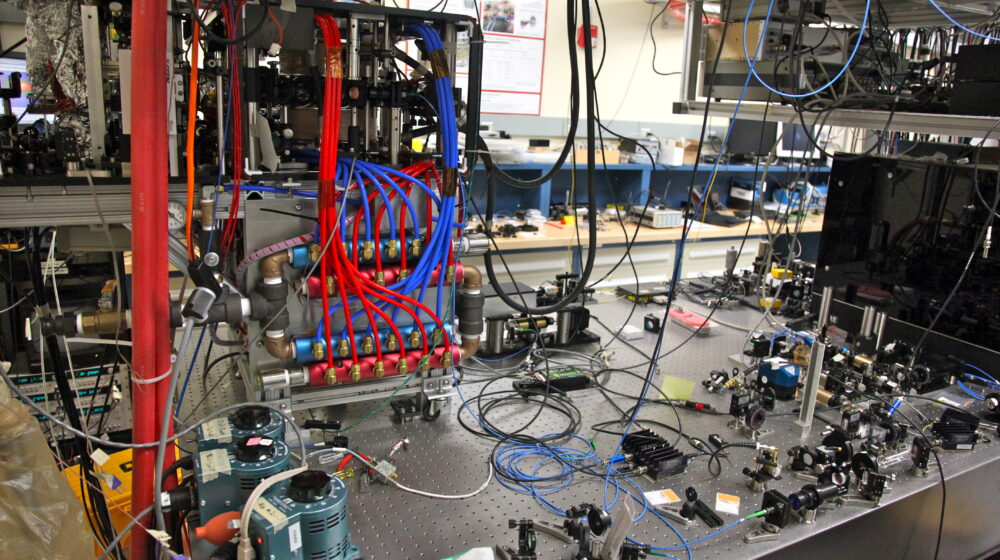
To study where time comes from, physicist Giovanni Barontini built a miniature universe inside his lab at the University of Birmingham — one small enough to fit on an optical table, but capable of producing its own version of a Big Bang and Big Crunch. The findings were published June 11 in Physical Review Research.
The motivation goes back to the Wheeler-DeWitt equation, central to quantum gravity, which describes the universe as a single system with no external time parameter — there is no clock ticking away outside it. Barontini’s hypothesis was that time is not a built-in feature of the universe but something that emerges from the interactions happening within it.
He tested this using a Bose-Einstein condensate, a state of matter formed by cooling around 24,000 atoms to near absolute zero, where they act as a single quantum ‘super particle.’ Trapping the condensate, he split it in two with a sheet of laser light and observed only one half, the ‘bright sector,’ while ignoring the other entirely.
As atoms drifted back and forth across the barrier, occasionally spilling over completely, Barontini named the moment they flooded the observed half the ‘Big Bang’ and the moment they receded the ‘Big Crunch.’ Instead of an external clock, he built an ‘entropic time’ tracking the disorder flowing between the two halves, and used it alone to order events within the system.
The result: time sped up, slowed down, and stopped, all depending on how fast the atoms moved. ‘Time was speeding up or slowing down, or even stopping, depending on what the system was doing,’ Barontini told Live Science, adding that both time’s existence and its forward direction seem to stem from an observer’s choice to ignore part of a system — the resulting ignorance, measured as entropy, is what generates the flow of time in the part being watched.

Leave a Reply